A Csikung testet átalakító tanításai
, az Yi Jin Jing néven ismert klasszikus tanításból származnak. A Yi Jin Jing pedig “Sinew-Changing Classics” néven ismert, azaz Ín-izom Átalakító Klasszikusok.
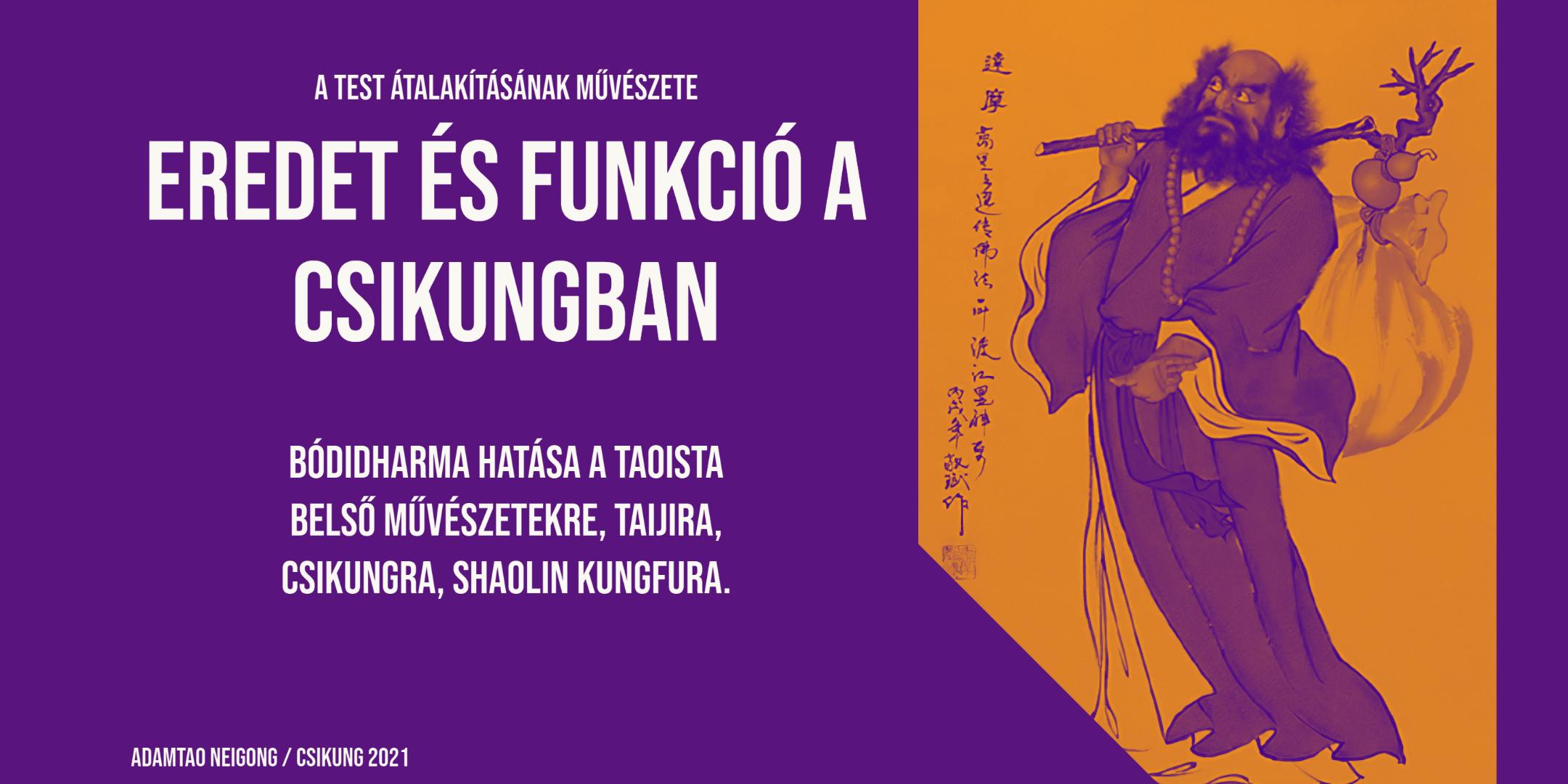
Többféle eredet történet ismeretes. Leginkább Bódhidharma nevéhez kötik, aki a 6. században Shaolin kolostorban adott át két iratot a szerzeteseknek, ezek egyike az Ín-izom Átalakító Klasszikusok. Látva a szerzetesek mennyire elhanyagolták a testi munkát, kidolgozott nekik egy gyakorlási rendszert.
Lényeges, hogy a legtöbb hagyományos csikung rendszer a Yi Jin Jingre épül. Azaz kellene , hogy alapuljon, de leginkább félre értelmezik, vagy elveszett út közben a lényegisége. Mégpedig, hogy a Yi Jin Jing nem gyakorlatok összessége, hanem konkrét alapelvek gyűjteménye.
Az tudható biztosan, hogy bárki is gyűjtötte össze és emelte ki az alapelveket, taoista módszertan alapján tette. És majdnem mindegyik Taoista Csikung rendszer a Yi Jin Jing alapelvein nyugszik.
Minderről bővebben Damo Mitchell – A Comprehensive Guide to Daoist Nei Gong című könyvében a 87. oldaltól olvashattok.
Esélyünk nyílik megállapítani, hogy autentikus e egy csikung rendszer, ha értjük valójában mire hozták létre a csikungot és milyen alapelveken nyugszik, akkor egy idő után el fogunk tudni igazodni a felkínált tanítások között is. Sokszor nem direkt félrevezetőek ezek a tanítások, csupán csak, légből kapott ismeretekre alapoznak. Olykor valami kevert, gyúrt elmélet alapján kialakított gyakorlatok halmaza.
A fő kitétele az Ín-izom Átalakító kéasszikusoknak, benne van a nevében, de nem lesz ilyen egyszerű értelmezni. Ha az lenne, mi is arra a következtetésre jutnánk, hogy különböző tárgyakkal ütögetni kell a testünket. Tévedés…
A könyvből szintén kiderül mit értettek az ősök “Ín” alatt, ez ki fogja terjeszteni a megértésünket a gyakorlatról. Mint ahogy az is hogy mit jelent a ‘csatornák megnyitása’ és a Qi (csi) áramlásának erősítése. Illetve ezek összefüggései.
Tehát át kell alakítanunk a testet, és ehhez nagy segítség az Yi Jin Jing ismerete , megértése, és gyakorlása. Gyakorlás nélkül nem igazán látom hogy menne végbe egy átalakulás. És igazából itt elbukik minden. Sokszor ’10 közül ezért jut át a vizsgán csak 1′. Bármit mesélhetek, bármit képzelhetek, az autentikus Csikungban a testen ‘tapintható’ , akár szó szerint is az eredmény.
Aki át szeretné alakítani a testét, annak először ismerni kell a Yi Jin Jing alapelveit, és azt hogy a Klasszikus hogy látja az emberi testet. Enélkül nehéz lesz megérteni az alapelveket. Vagy azt, hogy az adott Csikung iskola ennek megfelelően építi e fel az oktatását, azaz autentikus e.
Miért akarhatja valaki átalakítani a testét? Hogy gazdaságosabban működjön. A hosszú és “zökkenő mentesebb” életért. Esetleg magasabb célok. Hatékonyabb meditációs gyakorlás? Idő és perspektíva kérdése , hogy mi a cél. Legtöbben mégis az egészségükért fognak bele a gyakorlásba, ami egy tiszteletre méltó cél. Csak szomorú, hogy annyi a felhígított képzés, amelyek ugyan célul tűzik ki és fő “profiljuk” az egészség javítása, mégis sokszor hiú ígéret ez csupán, működő alapelvek és kitartó gyakorlás nélkül, csak ábránd mindez.
Míg a Yi Jin Jingre alapuló Csikung rendszerek, kevéssé hangoztatják mindezt, hangsúlyt főleg a helyes értésre és kivitelezésre és a napi gyakorlásra fektetnek, mellékhatásuk sokszor az egészség helyreállítása, vagy azon túli eredmények…
Annyira homályban tapogatózik az általános vélekedés a csikungról, hogy gondoltam ez a bejegyzés esetleg mankót nyújt. Az említett könyv őrült pontos instrukciókkal szolgál és nagyon messzire elvezeti a gyakorlót, de könyvből nem lehet csikungozni, tapasztalatból mondom, hogy a gyakorlás és a személyes oktatás kell a megértéshez és a helyes kivitelhez. Ma már azok a könyvek amiket a gyakorlás előtt olvastam teljesen mást mondanak nekem. Ami azt jelenti, hogy a gyakorlat és a változás bizony hat az elmére.
The body-transforming teachings of qi gong
, come from the classic teaching known as the Yi Jin Jing. The Yi Jin Jing is also known as the “Sinew-Changing Classics”.
Several origin stories are known. It is most often linked to the name of Bodhidharma, who in the 6th century at the Shaolin monastery handed two texts to the monks, one of which is the Sinew-Changing Classics. Seeing how much the monks neglected physical work, he devised a system of practice for them.
It is important that most traditional qi gong systems are built on the Yi Jin Jing. That is, they should be based on it, but it is mostly misunderstood, or its essence was lost along the way. Namely, that the Yi Jin Jing is not a collection of exercises but a collection of concrete principles.
What is certain is that whoever collected and highlighted these principles did so on the basis of Daoist methodology. And almost every Daoist qi gong system rests on the principles of the Yi Jin Jing.
You can read more about all this in Damo Mitchell’s book A Comprehensive Guide to Daoist Nei Gong, from page 87.
We have a chance to judge whether a qi gong system is authentic if we understand what qi gong was actually created for and what principles it rests on. Then, after a while, we will be able to find our way among the teachings on offer. Often these teachings are not deliberately misleading, they are merely based on knowledge plucked out of thin air. Sometimes they are a set of exercises put together on the basis of some mixed, kneaded-together theory.
The main premise of the Sinew-Changing Classics is in the name, but it will not be so simple to interpret. If it were, we too would conclude that we have to beat our body with various objects. A mistake…
The book also reveals what the ancients meant by “sinew”, which will widen our understanding of the practice. Just as it does what is meant by “opening the channels” and strengthening the flow of qi. And how these are connected.
So we have to transform the body, and for this, knowing, understanding and practising the Yi Jin Jing is a great help. Without practice I do not really see how a transformation could take place. And this is really where everything fails. Often “only 1 in 10 passes the exam” for this reason. I can tell any story, I can imagine anything, but in authentic qi gong the result can be “felt” on the body, even literally.
Whoever wants to transform their body must first know the principles of the Yi Jin Jing, and how the Classic sees the human body. Without this it will be hard to understand the principles. Or to understand whether a given qi gong school builds up its teaching accordingly, that is, whether it is authentic.
Why might someone want to transform their body? So that it works more economically. For a long life with fewer bumps. Perhaps for higher goals. More effective meditation practice? What the goal is is a question of time and perspective. Most people, however, begin practising for their health, which is a respectable goal. It is only sad that there is so much diluted training which, although they set it as their goal and their main “profile” is improving health, is often only an empty promise. Without working principles and persistent practice, it is all just a daydream.
While qi gong systems based on the Yi Jin Jing talk much less about all this and put the emphasis mainly on correct understanding and execution and on daily practice, their side effect is often the restoration of health, or results beyond that…
The general view of qi gong is groping so much in the dark that I thought this post might offer a crutch. The mentioned book gives crazily precise instructions and leads the practitioner very far, but you cannot do qi gong from a book. I say this from experience: practice and personal instruction are needed for understanding and for correct execution. Today the books I read before practising say something completely different to me. Which means that practice and change really do act on the mind.
Die körperverwandelnden Lehren des Qi Gong
, stammen aus der klassischen Lehre, die als Yi Jin Jing bekannt ist. Das Yi Jin Jing ist auch als „Sinew-Changing Classics“ bekannt, also die Klassiker der Sehnenwandlung.
Es sind mehrere Ursprungsgeschichten bekannt. Meist wird es mit dem Namen Bodhidharma verbunden, der im 6. Jahrhundert im Shaolin-Kloster den Mönchen zwei Schriften übergab, eine davon die Klassiker der Sehnenwandlung. Als er sah, wie sehr die Mönche die körperliche Arbeit vernachlässigt hatten, entwickelte er für sie ein Übungssystem.
Wichtig ist, dass die meisten traditionellen Qi-Gong-Systeme auf dem Yi Jin Jing aufbauen. Das heißt, sie sollten darauf beruhen, doch meistens wird es missverstanden, oder sein Wesentliches ist unterwegs verloren gegangen. Nämlich, dass das Yi Jin Jing keine Sammlung von Übungen ist, sondern eine Sammlung konkreter Prinzipien.
Sicher weiß man, dass derjenige, der die Prinzipien gesammelt und herausgearbeitet hat, wer auch immer es war, dies auf der Grundlage daoistischer Methodik getan hat. Und fast jedes daoistische Qi-Gong-System ruht auf den Prinzipien des Yi Jin Jing.
Mehr über all das könnt ihr in Damo Mitchells Buch A Comprehensive Guide to Daoist Nei Gong ab Seite 87 lesen.
Wir haben die Chance festzustellen, ob ein Qi-Gong-System authentisch ist, wenn wir verstehen, wofür das Qi Gong eigentlich geschaffen wurde und auf welchen Prinzipien es ruht. Dann werden wir uns nach einer Weile auch unter den angebotenen Lehren zurechtfinden. Oft sind diese Lehren nicht absichtlich irreführend, sie beruhen bloß auf aus der Luft gegriffenem Wissen. Manchmal sind sie eine Ansammlung von Übungen, die auf Grundlage irgendeiner zusammengemischten, zusammengekneteten Theorie entstanden ist.
Die Hauptaussage der Klassiker der Sehnenwandlung steckt schon im Namen, doch so einfach wird es nicht sein, sie zu deuten. Wäre es so, kämen auch wir zu dem Schluss, dass wir unseren Körper mit verschiedenen Gegenständen schlagen müssen. Ein Irrtum…
Aus dem Buch geht ebenfalls hervor, was die Alten unter „Sehne“ verstanden, und das wird unser Verständnis der Praxis erweitern. Ebenso wie das, was das „Öffnen der Kanäle“ und die Stärkung des Qi-Flusses (Chi) bedeutet. Und wie diese Dinge zusammenhängen.
Wir müssen also den Körper umwandeln, und dabei ist es eine große Hilfe, das Yi Jin Jing zu kennen, zu verstehen und zu üben. Ohne Übung sehe ich nicht wirklich, wie eine Umwandlung geschehen sollte. Und eigentlich scheitert genau hier alles. Oft „besteht deshalb nur 1 von 10 die Prüfung“. Ich kann alles Mögliche erzählen, mir alles Mögliche vorstellen: Im authentischen Qi Gong ist das Ergebnis am Körper „greifbar“, sogar wörtlich.
Wer seinen Körper umwandeln möchte, muss zuerst die Prinzipien des Yi Jin Jing kennen und wissen, wie der Klassiker den menschlichen Körper sieht. Ohne das wird es schwer, die Prinzipien zu verstehen. Oder zu erkennen, ob die jeweilige Qi-Gong-Schule ihren Unterricht entsprechend aufbaut, also ob sie authentisch ist.
Warum könnte jemand seinen Körper umwandeln wollen? Damit er wirtschaftlicher funktioniert. Für ein langes und „reibungsloseres“ Leben. Vielleicht höhere Ziele. Eine wirksamere Meditationspraxis? Was das Ziel ist, ist eine Frage der Zeit und der Perspektive. Die meisten beginnen dennoch um ihrer Gesundheit willen mit dem Üben, und das ist ein ehrenwertes Ziel. Traurig ist nur, dass es so viele verwässerte Ausbildungen gibt, die sich zwar die Verbesserung der Gesundheit zum Ziel setzen und sie zu ihrem Haupt„profil“ machen, doch oft ist das nur ein leeres Versprechen. Ohne funktionierende Prinzipien und beharrliches Üben ist all das bloß ein Traum.
Die auf dem Yi Jin Jing beruhenden Qi-Gong-Systeme hingegen betonen all das kaum, sie legen den Schwerpunkt vor allem auf das richtige Verständnis, die richtige Ausführung und das tägliche Üben, und ihre Nebenwirkung ist oft die Wiederherstellung der Gesundheit oder Ergebnisse, die darüber hinausgehen…
Die allgemeine Meinung über Qi Gong tappt so sehr im Dunkeln, dass ich dachte, dieser Beitrag könnte vielleicht eine Krücke bieten. Das erwähnte Buch liefert wahnsinnig genaue Anleitungen und führt den Übenden sehr weit, aber aus einem Buch kann man kein Qi Gong machen. Ich sage aus Erfahrung, dass es das Üben und den persönlichen Unterricht braucht, um zu verstehen und richtig auszuführen. Heute sagen mir die Bücher, die ich vor dem Üben gelesen habe, etwas völlig anderes. Was bedeutet, dass die Praxis und die Veränderung tatsächlich auf den Geist wirken.