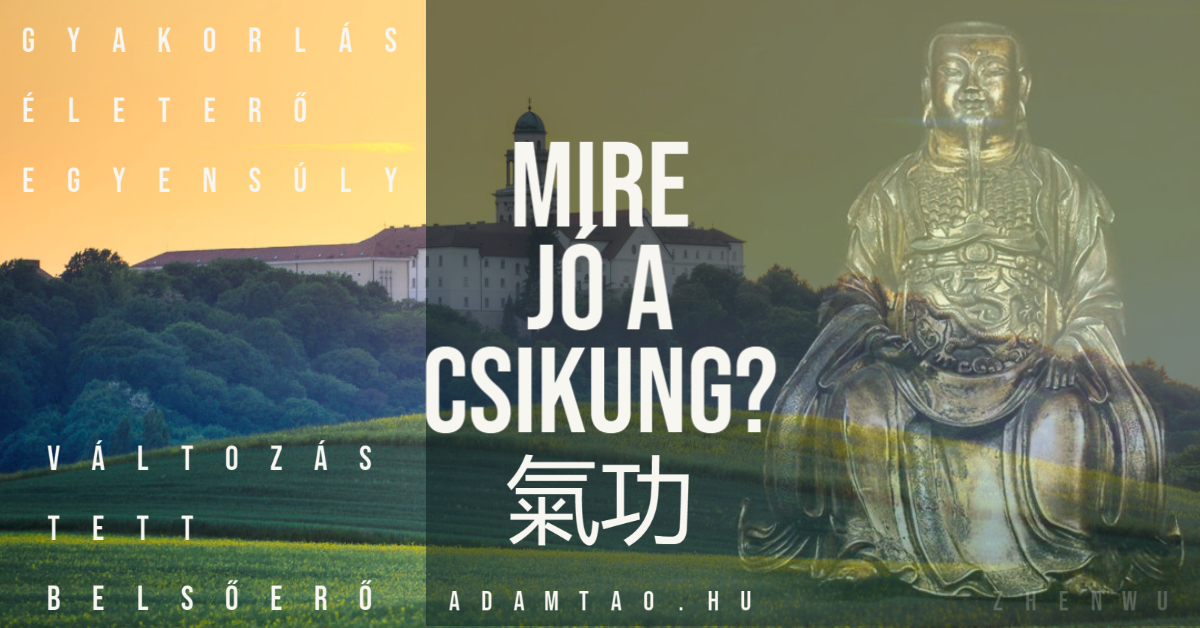
Ez egy másfajta “mire jó a csikung” bejegyzésnek ígérkezik.
Azt hiszem ezt a kérdést elsősorban az öngyógyítás iránti vágy generálja.
Elkezdjük érezni, hogy “valami nincs rendben” és válaszok után kutatunk. Néhányan a csikungba botlunk.
Számunkra pedig most az az érdekes, hogy a csikung ( Qi Gong – 氣功 ) micsoda? És hogyan érdemes hozzá állni?
Alapvetően, és az esetek többségében, nyugaton, alternatív megoldásnak tűnik. Misztikus is eléggé ahhoz, hogy elhigyjük erre, vagy arra jó. A dolog hátul ütője, hogy nem így működik, vagyis így pont nem működik a valódi csikung. Viszont a képzelt csikung nagyon is jól működik – érdekes módon. Azon a módon, ahogy egy képzelt csikung működhet. És ezt a lehető legjobb értelemben mondom, hiszen, ha valakit lelkesít, motivál, mozgásra ( elme, test ) késztet, azzal már nagyon jót tesz. De ettől még nem több, mint egy érdekesnek tartott torna. Vagy kiút.
A “Mire jó a csikung? “ – kérdést rendkívül hatásvadász módon szokták megválaszolni, felsorolva mindenféle egészségügyi probléma lehetséges orvoslását. Esetenként -sajnos, átlépve az etika és a kompetencia tűréshatárát, olyan területeket is megnevezve, amely már szakember bevonását igényelné. Kellemetlen ezt látni, és szerintem a csikung értékét csorbítja, vagy higítja.
A csikung gyakorlásnak vannak pozitív melléhatásai, sőt létezik egy komoly irányzat, amely gyógyászati csikung néven is értelmezhető, de ez utóbbi nagyon magas fokú felkészültséget és kínai orvosi és egyéb ismereteket igényel, nem beszélve a mélyreható csikung gyakorlati tapasztalatról. Azt látom, hogy sok esetben ez a tapasztalat nincs meg, a kínai orvosi képzés végképp, így marad tartalom és szaktudás nélküli ígéret. A zűrzavar legfőbb oka. És sok ember kiábrándultságának, vagy a csikung hiteltelenségének forrása.
Tehát a csikung arra lesz jó, amire hatékonyan alkamazni tudják. Ha az egészség javulás mellékhatás ( az egyszerű mozgástól is javulhat az egészség ), akkor kell legyen a gyakorlás mögött egy komolyabb mozgató rugó, vagy értelem. Tehát lesznek akik nem menekülésből, hanem inkább kíváncsiságból találnak a csikungra, megszólítja őket valami, és fel szeretnék deríteni.
Az egyik legelső dolog amit megtanultunk a tanárainktól, hogy ne valamiért gyakoroljunk, hiszen ez ellenkezik az egyik legfőbb alaptétellel, a nem cselekvéssel. A dolog nem így működik. Pontosan ellenkezőleg, sokkal hamarabb és gyorsabban érünk el eredményt, ha nem az eredményért gyakorlunk. Ennek felfedezése a gyakorlásban rejlik.
A csikung bele ágyazódik egy gyakorlási rendszerbe, amelynek elemei vannak, aspektusai, és összhatása. Ez a rendszer tartalmaz egy jellemző gondolkodásmódot, és része egy egységes világnézetnek, filozófiának és kozmológiának. Csak gazdagítja a gyakorlást, ha ezeket fel/meg ismerjük. Úgy gondolom a csikung izolált vizsgálata nem működik, másik rendszerbe helyezése gyökérteleníti a gyakorlást. Modernizálása felhigítja, és “mire jó a csikung” jellegű kérdés degradálja, kiszárítja.
Közben természetesen felsorolható, hogy a gyakorló mennyi pozitív mellékhatással találkozhat. Azonban ha ezek maradnak fókuszában sokáig, akkor gyakorlása egyre szűkül, lehetőségei a tanulásra csökkennek, és nem fog hozzáférni a rendszer teljes gazdagságához. Lehetetlen egyszerűen megválaszolni azt , hogy a csikung mire jó, mert rengeteg változótól függ.
A nagyon hatékony csikung, olyan változásokat hoz, amelyekről álmodni sem tudtunk, hiszen nem ismertük lényünk potenciáljait, beszűkültek az ismereteink, hiedelmek és dogmák, törvények kötnek. A hatástalan, felhigított csikung pedig illúziókat hoz, az elme képes elhinni bármit, és szeretné, ha a lehető legkisebb befektetéssel is nagy eredmények birtokosává válhatna. Eerre nagyon kellemetlen módon, olyan ígéreteket formálnak, amelyek a vágyainkat igyekeznek beteljesíteni, közben pedig elzárnak a valódi fejlődés, gyakorlás lehetőségétől.
Semmit se higyjünk el, tegyük próbára az elméleteket és a gyakorlatokat. Képtelen vagyok megígérni, hogy mire jó a csikung. Csupán azt a hagyomány örző tananyag rendszert tudom bemutatni, amit hasonlóan gondolkodó gyakorlóktól tanultam el. Az egyik legjobb tanács ami adható, mások jóléte érdekében, hogy gyakoroljanak könnyű szívvel derűsen. Gondtalanul. Ráérünk a gyakorlás után összerakni az elméleteket, és felvázolni céljainkat és az utat.
Klasszikus tételek:
– a Qi és a vér keringése összekapcsolódik. A csikung gyakorlásával erre az összetett rendszerre hathatunk. Ezt mindenki érzékelni fogja, aki gyakorol. A nei gong alapú csikung gyakorlás kifejezetten erőteljes e tekintetben.
– a legfőbb tulajdonsága, hogy szabályoz, meglévő, rendelkezésre álló Qi-t szabályozza. Fontos kiemelni , hogy a Hou Tian ( 后天 ) – Ég vagy születés utáni) tipusú csikungokra érvényes ez. A Xian Tian ( 先天 ) tipusú csikung egy teljesen más témakör.
– szabaddá, változékonnyá teszi a testet, olyan állapotba hozza, hogy fogékony legyen a változásokra, lereagálja, haladjon a behatásokra. Enélkül törékeny, fásult, merev lesz a test. Test, elme és tudat (szellem) a csikungban egységet alkot, egymásra folyamatosan ható változók.
– a csikung eszköz, csakúgy mint a dao yin ( 導引 ), vagy az ülő gyakorlás, a nei gong ( 內功 ) folyamatba illeszkedve a nei dan ( 內丹术 – belső alkímia ) irányába vezet, felkészít. Illetve a nei gong és a nei dan futhatnak párhuzamosan is egy idő után. A klasszikus taoista gyakorlásban a nei gong felkészítés, előszoba a nei danhoz. És mindennek több szinten fontos része a csikung és a (dao yin is).
– véleményem szerint a csikunggal lehetőségünk nyílik önmagunk művelésére. Míg a filozófia csupán intellektus kérdése, a gyakorlás által válik minden élővé.
– a test és az energia rendszer hatékonysága javul a gyakorlással, ennek következménye a robosztus egészség, teherbíró képesség, gyorsabb regenerálódás, és megannyi állapot, amelyet az egészséges életvitelhez kötnénk.
Nagyon leegyszerűsítve az embernek lehetősége van, hogy a kétféle energiát ami rendlekezésére áll beossza, szabályozza, raktározza és egy másfajta módon használja fel. Ha Hou Tian – Ég utáni energiáit megfelelően szabályozza, akkor kevesebbet használ fel a Xian Tian , azaz Ég előtti energiáiból, így harmonizálhatja életét, hosszabbíthatja meg azt és élhet gazdagabb módon a lehetőségeivel. Ha úgy tetszik az Ég előtti energiák szabályzásnak egyik fő állomása az Alsó Dan Tian felfedezése, felébresztése, és felépítése. Így nyílik módja a gyakorlónak, hogy egyfajta “tartalék generátorra” tegyen szert és szabályozza Ég utáni energiáinak felhasználását.
Az Események menüpontban, vagy a facebook oldalon követhetőek az aktuális gyakorló alkalmak. Remélem az útkeresők épülésére szolgálnak e sorok.
5 Elem Csikung Gyakorlatsor videó
Csikung – figyelem – gyakorlás , szabályzás
This promises to be a different kind of “what is qi gong good for” post.
I think this question is generated primarily by the desire for self-healing.
We start to feel that “something is not right” and we search for answers. Some of us stumble upon qi gong.
What interests us now is: what is qi gong ( Qi Gong – 氣功 ) actually? And how is it worth approaching?
Basically, and in most cases in the West, it seems to be an alternative solution. It is also mystical enough for us to believe it is good for this or that. The catch is that this is not how it works, or rather, this is exactly how real qi gong does not work. Imagined qi gong, however, works very well, interestingly enough. In the way an imagined qi gong can work. And I say this in the best possible sense, because if it inspires someone, motivates them, gets them moving ( mind, body ), that already does a lot of good. But that still makes it no more than an exercise routine that someone finds interesting. Or an escape.
The question “What is qi gong good for?” is usually answered in an extremely sensationalist way, listing the possible remedy of all kinds of health problems. Occasionally, unfortunately, overstepping the tolerance limits of ethics and competence, even naming areas that would already require the involvement of a professional. It is unpleasant to see this, and in my opinion it chips away at or dilutes the value of qi gong.
Qi gong practice has positive side effects, indeed there is a serious branch that can also be understood as medical qi gong, but the latter requires a very high level of preparation and Chinese medical and other knowledge, not to mention profound qi gong practical experience. I see that in many cases this experience is missing, and Chinese medical training certainly is, so what remains is a promise without content and expertise. This is the main cause of the confusion. And the source of many people’s disillusionment, or of qi gong’s lack of credibility.
So qi gong will be good for what it can be applied to effectively. If the improvement of health is a side effect ( health can improve even from simple movement ), then there must be a more serious driving force or sense behind the practice. So there will be people who find qi gong not out of escape but rather out of curiosity, something speaks to them, and they would like to explore it.
One of the very first things we learned from our teachers is not to practise for something, since this contradicts one of the most fundamental principles, non-action. It does not work like that. Quite the opposite: we reach results much sooner and faster if we do not practise for the result. The discovery of this lies in the practice.
Qi gong is embedded in a system of practice that has elements, aspects and an overall effect. This system contains a characteristic way of thinking, and is part of a unified worldview, philosophy and cosmology. It only enriches the practice if we recognise and get to know these. I think the isolated study of qi gong does not work, placing it in another system uproots the practice. Modernising it dilutes it, and a question like “what is qi gong good for” degrades it and dries it out.
Meanwhile, of course, one can list how many positive side effects the practitioner may encounter. However, if these remain the focus for long, then their practice narrows more and more, their possibilities for learning decrease, and they will not gain access to the full richness of the system. It is simply impossible to answer what qi gong is good for, because it depends on a great many variables.
Very effective qi gong brings changes we could never have dreamed of, because we did not know the potentials of our being, our knowledge has narrowed, and beliefs, dogmas and laws bind us. Ineffective, diluted qi gong, on the other hand, brings illusions: the mind is able to believe anything, and would like to become the owner of great results with the smallest possible investment. In a very unpleasant way, promises are formed for this that try to fulfil our desires, while shutting us off from the possibility of real development and practice.
Let us not believe anything, let us put the theories and the practices to the test. I am unable to promise what qi gong is good for. I can only present the tradition-preserving curriculum system that I learned from like-minded practitioners. One of the best pieces of advice that can be given, for the sake of the well-being of others, is to practise with a light heart, cheerfully. Carefree. We have time to put the theories together and sketch out our goals and the path after practising.
Classical propositions:
– the circulation of qi and blood are connected. Through qi gong practice we can influence this complex system. Everyone who practises will perceive this. Nei gong based qi gong practice is particularly powerful in this respect.
– its main characteristic is that it regulates, it regulates the existing, available qi. It is important to emphasise that this applies to Hou Tian ( 后天 ) – after heaven, or post-birth) type qi gong. Xian Tian ( 先天 ) type qi gong is a completely different subject.
– it makes the body free and changeable, brings it into a state in which it is receptive to changes, reacts to them, and progresses with the influences. Without this the body becomes brittle, numb, rigid. Body, mind and consciousness (spirit) form a unity in qi gong, variables that continually act on each other.
– qi gong is a tool, just like dao yin ( 導引 ), or sitting practice; fitted into the nei gong ( 內功 ) process, it leads towards and prepares for nei dan ( 內丹术 – inner alchemy ). Nei gong and nei dan can also run in parallel after a while. In classical Daoist practice, nei gong is the preparation, the antechamber to nei dan. And qi gong (and dao yin too) is an important part of all this on several levels.
– in my opinion, qi gong gives us the opportunity to cultivate ourselves. While philosophy is merely a matter of intellect, through practice everything comes alive.
– the efficiency of the body and the energy system improves with practice, the consequence of which is robust health, load-bearing capacity, faster regeneration, and many states that we would associate with a healthy way of life.
Very simply put, a person has the opportunity to allocate, regulate and store the two kinds of energy at their disposal, and to use them in a different way. If they properly regulate their Hou Tian, after-heaven energies, they use up less of their Xian Tian, that is, before-heaven energies, so they can harmonise their life, lengthen it and live their possibilities in a richer way. If you like, one of the main stations of regulating the before-heaven energies is the discovery, awakening and building of the lower dan tian. This is how the practitioner gets the opportunity to acquire a kind of “reserve generator” and to regulate the use of their after-heaven energies.
The current practice sessions can be followed in the Events menu item, or on the Facebook page. I hope these lines serve the edification of those seeking a path.
Five phases (Wu Xing) qi gong practice sequence video
Qi gong: attention, practice, regulation
Das verspricht ein etwas anderer „Wofür ist Qi Gong gut“-Beitrag zu werden.
Ich glaube, diese Frage entsteht vor allem aus dem Wunsch nach Selbstheilung.
Wir beginnen zu spüren, dass „etwas nicht stimmt“, und suchen nach Antworten. Einige von uns stolpern dabei über Qi Gong.
Für uns ist jetzt interessant, was Qi Gong ( Qi Gong – 氣功 ) eigentlich ist. Und wie man sich ihm am besten nähert.
Grundsätzlich, und in den meisten Fällen, erscheint es im Westen als alternative Lösung. Es ist auch mystisch genug, dass wir glauben, es sei für dies oder jenes gut. Der Haken an der Sache: So funktioniert es nicht, genauer gesagt, gerade so funktioniert echtes Qi Gong nicht. Ein eingebildetes Qi Gong funktioniert dagegen sehr gut, interessanterweise. Auf die Weise, wie ein eingebildetes Qi Gong eben funktionieren kann. Und das meine ich im bestmöglichen Sinne, denn wenn es jemanden begeistert, motiviert, zur Bewegung ( Geist, Körper ) anregt, dann tut es damit schon sehr viel Gutes. Aber deshalb ist es noch nicht mehr als eine Gymnastik, die man interessant findet. Oder ein Ausweg.
Die Frage „Wofür ist Qi Gong gut?“ wird meist äußerst reißerisch beantwortet, mit einer Aufzählung der möglichen Heilung aller möglichen gesundheitlichen Probleme. Manchmal werden dabei leider die Grenzen von Ethik und Kompetenz überschritten und sogar Bereiche genannt, die bereits die Einbeziehung einer Fachperson erfordern würden. Das ist unangenehm zu sehen, und meiner Meinung nach schmälert oder verwässert es den Wert des Qi Gong.
Die Qi Gong Praxis hat positive Nebenwirkungen, es gibt sogar eine ernsthafte Richtung, die man als medizinisches Qi Gong verstehen kann, doch Letzteres erfordert eine sehr hohe Vorbereitung sowie Kenntnisse der chinesischen Medizin und weitere, ganz zu schweigen von tiefgehender praktischer Erfahrung im Qi Gong. Ich sehe, dass diese Erfahrung in vielen Fällen fehlt, die Ausbildung in chinesischer Medizin erst recht, und so bleibt ein Versprechen ohne Inhalt und Fachwissen. Das ist die Hauptursache der Verwirrung. Und die Quelle der Ernüchterung vieler Menschen oder der Unglaubwürdigkeit des Qi Gong.
Qi Gong wird also für das gut sein, wofür man es wirksam einzusetzen versteht. Wenn die Verbesserung der Gesundheit eine Nebenwirkung ist ( Gesundheit kann sich auch durch einfache Bewegung verbessern ), dann muss hinter der Praxis eine ernsthaftere Triebfeder oder ein tieferer Sinn stehen. Es wird also Menschen geben, die nicht aus Flucht, sondern eher aus Neugier zum Qi Gong finden: Etwas spricht sie an, und sie möchten es erkunden.
Eines der allerersten Dinge, die wir von unseren Lehrern gelernt haben, ist, nicht für etwas zu üben, denn das widerspricht einem der wichtigsten Grundsätze, dem Nicht-Handeln. So funktioniert es nicht. Ganz im Gegenteil: Wir kommen viel eher und schneller zu Ergebnissen, wenn wir nicht für das Ergebnis üben. Die Entdeckung dessen liegt in der Übung.
Qi Gong ist in ein Übungssystem eingebettet, das Elemente, Aspekte und eine Gesamtwirkung hat. Dieses System enthält eine charakteristische Denkweise und ist Teil einer einheitlichen Weltanschauung, Philosophie und Kosmologie. Es bereichert die Praxis nur, wenn wir diese erkennen und kennenlernen. Ich glaube, eine isolierte Betrachtung des Qi Gong funktioniert nicht, und es in ein anderes System zu versetzen, entwurzelt die Praxis. Seine Modernisierung verwässert es, und eine Frage wie „Wofür ist Qi Gong gut“ degradiert es und lässt es austrocknen.
Natürlich kann man dabei aufzählen, wie viele positive Nebenwirkungen dem Übenden begegnen können. Wenn diese jedoch lange im Mittelpunkt bleiben, wird seine Praxis immer enger, seine Möglichkeiten zu lernen nehmen ab, und er wird keinen Zugang zum ganzen Reichtum des Systems finden. Es ist unmöglich, einfach zu beantworten, wofür Qi Gong gut ist, denn es hängt von sehr vielen Variablen ab.
Sehr wirksames Qi Gong bringt Veränderungen, von denen wir nicht einmal zu träumen wagten, denn wir kannten die Potenziale unseres Wesens nicht, unser Wissen ist eingeengt, Glaubenssätze und Dogmen, Gesetze binden uns. Wirkungsloses, verwässertes Qi Gong dagegen bringt Illusionen: Der Geist kann alles glauben und möchte mit dem kleinstmöglichen Einsatz große Ergebnisse besitzen. Darauf werden auf sehr unangenehme Weise Versprechen zugeschnitten, die unsere Wünsche zu erfüllen suchen und uns dabei von der Möglichkeit echter Entwicklung und echter Übung abschneiden.
Glauben wir nichts, stellen wir die Theorien und die Übungen auf die Probe. Ich kann unmöglich versprechen, wofür Qi Gong gut ist. Ich kann nur das traditionsbewahrende Lehrsystem vorstellen, das ich von gleichgesinnten Praktizierenden gelernt habe. Einer der besten Ratschläge, den man zum Wohle anderer geben kann, ist, mit leichtem Herzen und heiter zu üben. Unbeschwert. Wir haben nach dem Üben Zeit genug, die Theorien zusammenzufügen und unsere Ziele und den Weg zu skizzieren.
Klassische Grundsätze:
– Die Zirkulation von Qi und Blut ist miteinander verbunden. Durch die Qi Gong Praxis können wir auf dieses komplexe System einwirken. Das wird jeder wahrnehmen, der übt. Eine auf Nei Gong basierende Qi Gong Praxis ist in dieser Hinsicht ausgesprochen kraftvoll.
– Seine wichtigste Eigenschaft ist, dass es reguliert, es reguliert das vorhandene, verfügbare Qi. Es ist wichtig zu betonen, dass dies für Qi Gong vom Typ Hou Tian ( 后天 ) – nach dem Himmel oder nach der Geburt) gilt. Qi Gong vom Typ Xian Tian ( 先天 ) ist ein völlig anderes Thema.
– Es macht den Körper frei und wandelbar, bringt ihn in einen Zustand, in dem er für Veränderungen empfänglich ist, auf sie reagiert und mit den Einwirkungen voranschreitet. Ohne dies wird der Körper zerbrechlich, abgestumpft, steif. Körper, Geist und Bewusstsein (Geistseele) bilden im Qi Gong eine Einheit, Variablen, die ständig aufeinander einwirken.
– Qi Gong ist ein Werkzeug, genauso wie Dao Yin ( 導引 ) oder die Sitzpraxis; eingebettet in den Prozess des Nei Gong ( 內功 ) führt es in Richtung Nei Dan ( 內丹术 – innere Alchemie ) und bereitet darauf vor. Nach einiger Zeit können Nei Gong und Nei Dan auch parallel laufen. In der klassischen daoistischen Praxis ist Nei Gong die Vorbereitung, das Vorzimmer zum Nei Dan. Und ein wichtiger Teil von alledem ist auf mehreren Ebenen das Qi Gong (und auch das Dao Yin).
– Meiner Meinung nach eröffnet uns Qi Gong die Möglichkeit, uns selbst zu kultivieren. Während die Philosophie nur eine Frage des Intellekts ist, wird durch die Übung alles lebendig.
– Die Leistungsfähigkeit des Körpers und des Energiesystems verbessert sich durch die Übung; die Folge davon sind robuste Gesundheit, Belastbarkeit, schnellere Regeneration und viele Zustände, die wir mit einer gesunden Lebensweise verbinden würden.
Sehr vereinfacht gesagt hat der Mensch die Möglichkeit, die zwei Arten von Energie, die ihm zur Verfügung stehen, einzuteilen, zu regulieren, zu speichern und auf eine andere Weise zu nutzen. Wenn er seine Hou Tian Energien, also die Energien nach dem Himmel, richtig reguliert, verbraucht er weniger von seinen Xian Tian Energien, also den Energien vor dem Himmel, und kann so sein Leben harmonisieren, es verlängern und seine Möglichkeiten reicher leben. Wenn man so will, ist eine der wichtigsten Stationen bei der Regulierung der Energien vor dem Himmel die Entdeckung, das Erwecken und der Aufbau des unteren Dan Tian. So erhält der Übende die Möglichkeit, eine Art „Reservegenerator“ zu gewinnen und den Verbrauch seiner Energien nach dem Himmel zu regulieren.
Im Menüpunkt Veranstaltungen oder auf der Facebook-Seite kannst du die aktuellen Übungstermine verfolgen. Ich hoffe, diese Zeilen dienen allen, die einen Weg suchen, zur Erbauung.
Video: Fünf-Elemente-Qi-Gong-Übungsfolge
Qi Gong: Aufmerksamkeit, Übung, Regulierung